


Shock Vulcanization Strategies in Silicone Extrusion
In silicone extrusion, developing and maintaining products with custom geometries is a major challenge. Without any crosslinking, uncured, unprocessed silicone does not possess shape memory, which is imparted during the curing process. However, the total curing process can take several minutes, even at high temperatures >200 °C.[1] Thus, not only is shaping silicone difficult due to its tendency to expand after being shaped by the extrusion die, but maintaining its shape during the curing process is also a significant challenge. Moreover, this challenge is especially relevant for horizontal extrusion lines, where the profiles are subject to the influence of gravity, which can cause the desired geometry to sag or flatten if improperly processed.
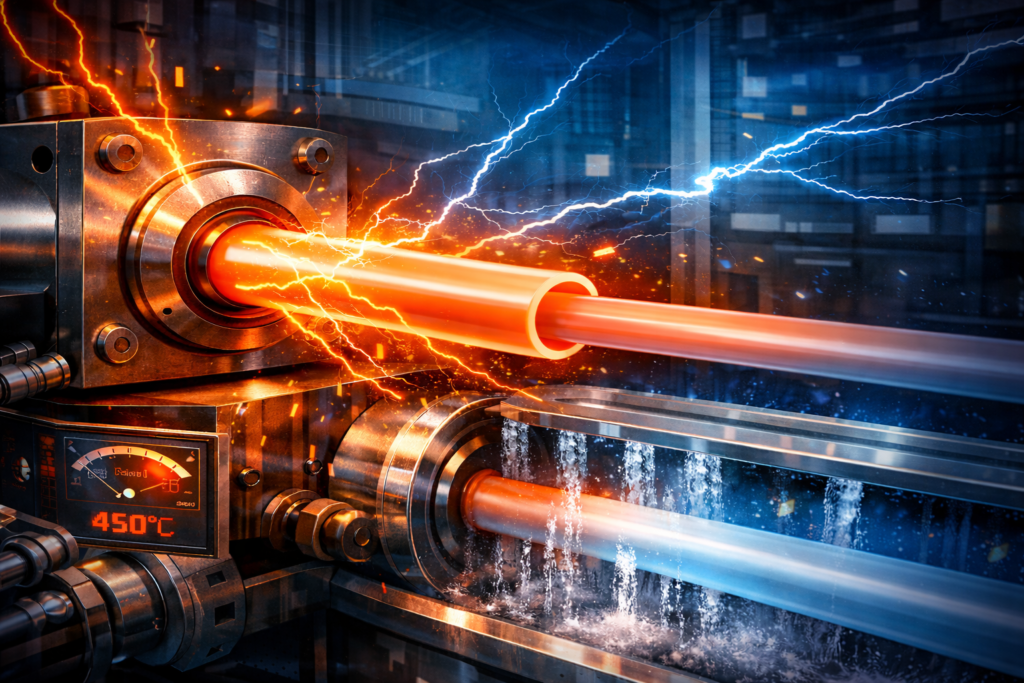
To overcome this challenge, an often applied technique is shock vulcanization (also known as shock curing), in which the outer surface of the extrudate is rapidly exposed to high temperature, typically by passing it through a small chamber operating at extremely high temperatures (> 600 °C).[2, 3] This process cures the outside of the extrudate, firmly locking in the outer geometry, while the core continues to crosslink more gradually. Immediately stabilizing the surface through shock curing helps prevent collapse, sticking, or distortion in softer profiles, such as tubes or hollow sections, that might otherwise lose dimensional accuracy.[1]
By quickly setting the outer layer, shock curing allows the extrudate to be transported along conveyors or through ovens with minimal deformation, while the interior curing completes under controlled heating. The technique also enables higher line speeds and reduces handling issues in continuous production.
Although this process may seem simple, shock curing systems require careful control. Most notably, there is a fine balance between extrusion run-speed and operating temperature of the shock curing chamber. Excessive surface curing compared to the core can lead to internal stress and cracking. In extreme cases, the extrudate may exceed its autoignition temperature and spontaneously ignite, posing a severe safety hazard. Conversely insufficient shock curing leads to noticeable product deformation, rendering the final product unsuitable for use.
At Jehbco, we have over 50 years experience in extruding silicone in both basic and complex geometries, and utilizing shock curing systems to ensure your products are replicated with extremely precise tolerances on product geometries, without any formation of defects. For more information, check out our extrusion catalogue, and please contact us through our website portal.
References
- Wacker Chemie, SOLID AND LIQUID SILICONE RUBBER MATERIAL AND PROCESSING GUIDELINES.
- Twin Engineers. Continuous Infrared Vulcanization System for Silicon Rubber. 2025; Available from: https://www.electronicdrying.com/product/continuous_infrared_vulcanization.
- Rubicon. INFRARED SHOCK TUNNEL. 2025; Available from: https://www.rubicon-halle.de/en/products/vulcanization-lines/silicone/infrared-shock-tunnel.