


Medical & Food Grade Silicone Tubing – The Best Choice for Peristaltic Pumps, Medical Devices & Drinking Water Systems
Selecting the right tubing isn’t just a line item – it’s critical for product purity, user safety, and uptime. Medical grade silicone tubing delivers the ideal blend of biocompatibility, thermal stability, flex-fatigue resistance, and sterilisation versatility that makes it a top choice for peristaltic pumps, surgical/respiratory equipment, pharmaceutical transfer, diagnostics, and even drinking water systems.
Jehbco Silicones manufactures high-precision silicone tubing in Sydney, supporting Australian and global OEMs with short lead times, custom dimensions, and certified quality. We operate an ISO 9001-certified Quality Management System, and our dimensional tolerances surpass standards specified under ISO 3302-1 (dimensional classes) and ISO 3302-2 (geometrical tolerances). Jehbco ISO 9001, ISO 3302-1 overview, ISO 3302-2 overview.
We’re proud to supply leading organisations including Mediquip and to provide tubing used in drinking water systems for Zip Water.
Why Medical Grade Silicone Tubing?
Proven biocompatibility
Medical grades are selected and tested for contact with human tissue and fluids, typically referencing ISO 10993 and/or USP Class VI biological evaluations, and – where relevant – FDA 21 CFR 177.2600 for elastomers in contact applications. Helpful primers: ISO 10993 vs. USP Class VI, and an overview including 21 CFR 177.2600 context: KEF America.
Wide working temperature range
Silicone maintains flexibility and key physical properties across a broad range (commonly -60 °C to +200 °C, with short-term higher peaks depending on grade), enabling both hot and cold processes and repeated sterilisation. Temperature references: Hanna Rubber technical sheet, Silclear note.
Chemical & taste/odour neutrality
Silicone’s inertness helps protect product integrity in pharma and biotech media transfer and potable-water flow paths. Background on medical rubber compounds and extractables: Apple Rubber medtech guide (PDF).
Sterilisation versatility
Compatible with steam/autoclave, ethylene oxide (EtO), and gamma/e-beam irradiation – a key advantage for reusable sets or validated single-use assemblies. Effects of sterilisation on silicone rubbers: Saint-Gobain study (PDF).
Key Applications of Medical & Food Grade Silicone Tubing
1) Peristaltic pumps (filling, dosing, media transfer)
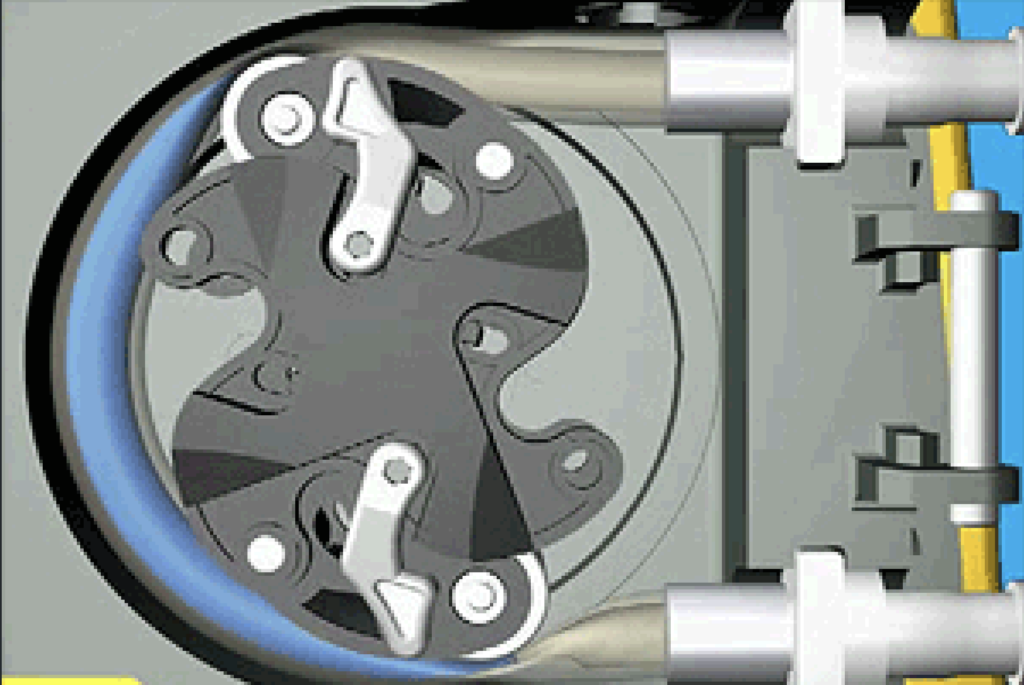
Peristaltic pumps move fluid by compressing and releasing the tubing – the fluid never touches the pump mechanism, reducing contamination risk and simplifying cleaning validation. Silicone is ideal because it resists kinking, recovers after repeated compression (occlusion), and maintains stable flow over long duty cycles.n Principles and material stresses: Arrow explainer and Saint-Gobain on occlusion & spallation.
What to specify: inner diameter (ID) and wall thickness to hit target flow/pressure; pump-grade silicone for rebound and fatigue life; and validated sterilisation method (e.g., EtO vs. autoclave) per your device file.
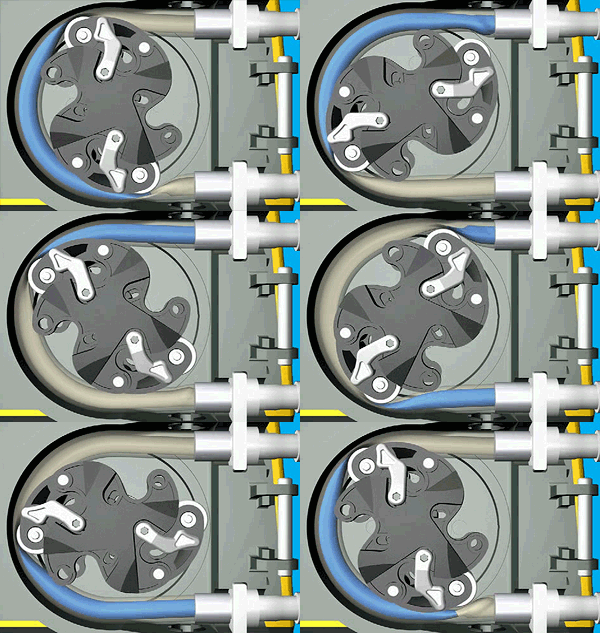
Figure 1. Peristaltic pump mechanism – Fluid is moved by sequential compression and release of flexible tubing, ensuring the liquid never contacts the pump components. This design minimises contamination and supports easy cleaning. Animation by Watson-Marlow Pumps Group: http://www.watson-marlow.com/
2) Surgical suction, anaesthesia & respiratory equipment
Silicone tubing tolerates repeated steam sterilisation and resists collapse under vacuum in operating-theatre suction lines and respiratory circuits. Process notes on sterilisation impacts: Saint-Gobain study (PDF).
3) Pharmaceutical & bioprocessing transfer
Smooth-bore silicone helps minimise hold-up and microbial niches in transfer lines, filtration skids and single-use assemblies. Common validated sterilisation routes for tubing include autoclave, EtO and irradiation (see DuPont Liveo note).
4) Diagnostics & laboratory automation
In analyser manifolds and reagent lines, silicone’s chemical compatibility and low extractables support stable baselines and repeatable results. Further background: Apple Rubber medtech guide (PDF).
5) Drinking water systems (Zip Water)
Silicone tubing is also used in point-of-use drinking water systems where purity, taste neutrality, and flexibility in compact spaces are critical. Jehbco provides tubing for drinking water systems for Zip Water. Silicone’s low taste/odour transfer and thermal resilience suit both ambient and heated dispensing paths (e.g., boiling/chilled mixer systems), and its clean extrusion surface finish supports hygienic design.
Why Choose Jehbco Silicones for Medical Grade Silicone Tubing?
Australian manufacturing, global standards.
Jehbco designs and extrudes silicone tubing at our Sydney-based manufacturing facility for medical, pharmaceutical, biotech and water-appliance customers. Our in-house tooling and extrusion let us control dimensional accuracy, surface finish and traceability from raw material to finished product. Explore: About Jehbco, Products.
Trusted by leading organisations.
We supply to Mediquip and provide tubing used in drinking water systems for Zip Water – two examples that reflect our ability to meet demanding compliance, logistics and performance requirements.
Certified quality you can audit.
- ISO 9001 certification underpins our quality system, internal auditing and continuous improvement. See: Jehbco on ISO 9001 and Quality assurance.
- Dimensional & geometrical tolerances aligned to ISO 3302-1 (classes for extruded/moulded solid rubber) and ISO 3302-2 (flatness, parallelism, perpendicularity, coaxiality, positional). Standard abstracts: ISO 3302-1, ISO 3302-2. (Free sample previews: ISO 3302-1 sample PDF, ISO 3302-2 sample PDF.)
Engineered for your device or line.
- Custom IDs/ODs/walls to hit exact flow and pressure targets in peristaltic heads.
- Material choice (e.g., pump-grade platinum-cured silicones) for rebound, clarity and low extractables.
- Sterilisation-ready: guidance on trade-offs among autoclave, EtO and gamma/e-beam for your process and part geometry. See overviews: Saint-Gobain, TBL Plastics.
Local support, shorter lead times.
Being based in Sydney helps reduce supply risk, support PPAP/FAI requests faster, and keep projects moving from prototype to validated production. See our latest news and articles: Jehbco Articles.
Quick Spec Tips for Engineers & Buyers
- Dimensioning for peristaltic pumps: match ID to the desired flow at your pump’s RPM/occlusion; use wall thickness sufficient to resist vacuum and collapse without overstressing the head. Primers: Arrow peristaltic pump basics; Saint-Gobain on occlusion & spallation.
- Thermal envelope: standard silicone grades typically operate –60 °C to +200 °C (with short-term peaks higher by formulation)—confirm against your sterilisation or hot-water profile. References: Hanna Rubber, Silclear.
- Compliance evidence: where required, request documentation aligning to ISO 10993/USP Class VI testing history and 21 CFR 177.2600 for contact materials. Overviews: KEF America, Rubber Group.
- Tolerances: specify tolerance class per ISO 3302-1 and relevant geometric call-outs per ISO 3302-2 for critical fits and pump head interfaces. Standards: ISO 3302-1, ISO 3302-2.
Work with Jehbco
If you need medical grade silicone tubing for peristaltic pump sets, surgical/respiratory equipment, diagnostics, bioprocessing or drinking water systems, our team can help you finalise dimensions, choose the right material, and plan for sterilisation and validation – locally and quickly.
- Explore products: com.au/products
- About us: com.au/about
- Get in touch with the Jehbco Sales team: sales@jehbco.com.au
References & Further Reading
Jehbco quality & certification
- ISO 9001 at Jehbco: https://jehbco.com.au/iso-9001-a-standard-of-quality-for-jehbco/
- Quality assurance overview: https://jehbco.com.au/quality-assurance-at-jehbco/
Standards cited
- ISO 3302-1 (dimensional tolerances) abstract: https://www.iso.org/standard/62492.html (sample PDF: https://cdn.standards.iteh.ai/samples/62492/7805d37c65df4c59a262d6e48a78a9e9/ISO-3302-1-2014.pdf)
- ISO 3302-2 (geometrical tolerances) abstract: https://www.iso.org/standard/84074.html (sample PDF: https://cdn.standards.iteh.ai/samples/84074/08c15e837d374738a7fc11e1fb27507d/ISO-3302-2-2022.pdf)
Biocompatibility frameworks
- ISO 10993 vs. USP Class VI (primer): https://rubber-group.com/iso-10993-vs-usp-class-vi-medical-molding/
- FDA 21 CFR 177.2600, ISO 10993 overview: https://www.kef-america.com/which-biocompatible-sealing-materials-meet-fda-iso-10993-and-usp-class-vi-standards/
Peristaltic pump principles & tubing stresses
- How peristaltic pumps work: https://www.arrow.com/en/research-and-events/articles/how-peristaltic-pumps-work-in-medical-applications-and-beyond
- Occlusion & spallation in tubing: https://www.medical.saint-gobain.com/resources/blog/understanding-spallation-peristaltic-pumps
Temperature & sterilisation references
- Silicone temperature range (-60 °C to +200 °C typical): https://hannarubbercompany.com/wp-content/uploads/sites/22/2025/01/Silicone-Rubber.pdf, https://silclear.com/silicone-heat-resistant-thermal-stability/
- Sterilisation (autoclave, EtO, gamma/e-beam): https://www.biopharm.saint-gobain.com/sites/hps-mac3-lifesciences-bioprocess/files/effect-of-sterilization-on-the-mechanical-properties-of-silicone-rubbers.pdf?cache=iyXoe7VI, https://www.dupont.com/content/dam/dupont/amer/us/en/liveo/public/documents/en/DIGITAL_A4_EN_Liveo_Pharma_Advanced_Pump_Tubing_APT_05-1181-01.pdf, https://tblplastics.com/sterilize-platinum-peroxide-cured-silicone/