


Shore A Hardness of Silicone Rubber – What It Means and Why It Matters
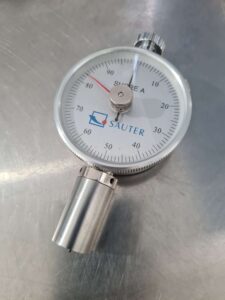
Figure 1. Sauter Shore A durometer in use at Jehbco Silicones.
When specifying a silicone rubber for an extrusion, gasket, seal, sleeve, or custom profile, one of the first numbers you’ll see is Shore A hardness. It’s often treated as a quick “soft vs firm” indicator, but Shore A hardness influences far more than feel. It affects how a silicone part seals, wears, installs, handles pressure, and maintains performance over time.
This article explains what Shore A hardness is, how it relates to real-world material properties, and how to select the right hardness for different applications.
What is Shore A hardness?
Shore A hardness is a standardised way of measuring the hardness of elas
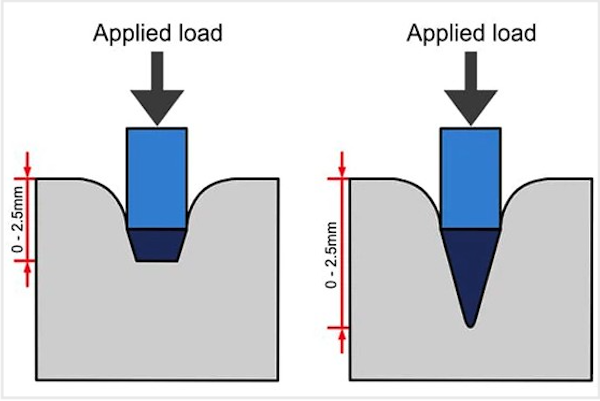
tomers (rubbers). It is measured with a handheld instrument called a durometer that presses an indenter into the material under a defined force. The durometer reports a value from 0 to 100 based on how far the indenter penetrates: deeper penetration = softer material, and less penetration = harder material. The level of penetration is converted into a Shore A hardness rating where:
- Lower numbers (e.g., 20A–40A) mean a softer, more compliant rubber.
- Higher numbers (e.g., 60A–80A+) mean a firmer, more resistant rubber.
Shore A is most commonly used for rubbers like silicone, EPDM, nitrile, and neoprene. Very soft gels may be measured on Shore 00, while very hard plastics are often measured on Shore D (see Fig. 3).
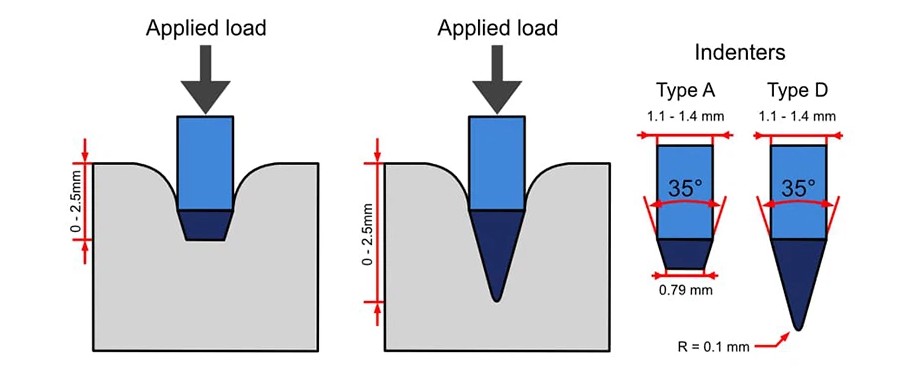
Figure 2. Indenters of Shore A and Shore D durometers. (Source: https://www.lindeseals.com/news/what-is-shore-a-hardness-78017418.html)
Why hardness matters in silicone rubber performance
Hardness is not a direct measurement of strength, but it correlates with several important performance characteristics.
1) Compression and sealing performance
Silicone seals by deforming to fill gaps and maintain contact pressure. In general:
- Softer silicone (lower Shore A) conforms more easily to irregular surfaces and requires less clamping force to achieve a seal.
- Harder silicone (higher Shore A) resists deformation and can maintain sealing shape under load but may require higher clamp loads and better mating surface quality.
A hardness that is too soft may extrude out of a joint or lose contact pressure over time. Too hard, and it may not conform well enough to seal at all.
2) Compression set (ability to “spring back”)
Compression set describes how well rubber returns to its original thickness after being compressed for a period. While formulation matters greatly, hardness selection plays a role:
- Very soft compounds can be more prone to taking a “set” in high-compression static joints.
- Medium hardness compounds often offer a useful balance of compliance and recovery.
- Higher hardness compounds can resist permanent deformation, but if they don’t compress enough, sealing can be inconsistent.
For critical sealing, it’s best to consider hardness together with compression set data at the relevant temperature and time.
3) Tensile strength and tear resistance
Hardness does not automatically equal strength, but typical trends include:
- Moving from very soft to medium hardness often increases tear strength and resistance to nicking during installation.
- Very hard compounds may resist indentation well but can be more sensitive to sharp notches depending on formulation.
For extrusions that will be stretched, pulled, clipped, or fitted over edges, tear strength and elongation can matter as much as hardness.
4) Abrasion, wear, and surface durability
Harder silicone generally offers improved resistance to surface indentation and can perform better in applications involving sliding contact, minor rubbing, or repeated handling. Softer grades can be excellent for gentle sealing, but may mark, scuff, or wear faster in dynamic contact.
If the part sees repeated movement (e.g., door sweeps, wipe seals, protective sleeves), hardness selection should be aligned with the wear mechanism.
5) Flexibility, handling, and installation
Hardness strongly influences how a silicone extrusion behaves during manufacturing and installation:
- Lower Shore A profiles are easier to compress and can be simpler to fit into uneven gaps but may be more difficult to push into tight retaining channels without stretching.
- Higher Shore A profiles can feed and handle more “crisply” and can be easier to install into certain carrier systems but may not tolerate misalignment or variable gaps as well.
For snap-fit designs, barbed profiles, or tight-tolerance grooves, a small change in hardness can noticeably change the “feel” and retention performance.
Shore A hardness and tolerances: why the “fit” matters
In real assemblies, seals must work across tolerance stack-ups—variation in groove sizes, flange flatness, paint thickness, door gaps, and installation alignment. Shore A hardness affects how well silicone can absorb that variation:
- Softer silicone (lower Shore A) compresses more easily and conforms to uneven surfaces, making it more forgiving when gaps vary. The trade-off is that it can over-compress in tight areas, increasing closure/clamp force and potentially reducing service life if the design doesn’t control compression.
- Harder silicone (higher Shore A) resists deformation and holds its shape better but typically needs tighter tolerances or higher clamp loads to achieve consistent compression—otherwise it may not compress enough to seal at the “large gap” end of the tolerance range.
For reliable sealing, hardness should be selected alongside the target compression range and the expected minimum/maximum gap. Where tolerances are wide, geometry can help (e.g., hollow bulbs, multi-lip profiles etc.) so the seal remains effective without excessive force.
Typical Shore A hardness ranges for silicone rubber
There is no single “best” hardness. Selection depends on what the part must do.
Very soft (10A–30A)
Used where high conformity is needed: gentle sealing, cushioning, vibration isolation, soft grips, sensitive contact surfaces.
Soft–medium (30A–50A)
A common range for general-purpose seals and extrusions: good compliance with improved handling and tear resistance.
Medium–firm (50A–70A)
Often chosen for robust gasket profiles, higher clamp loads, parts that must resist deformation, and applications where the seal must hold its shape.
Firm–hard (70A–90A+)
Used for parts needing high resistance to indentation and deformation, tight dimensional stability, or more “structural” elastomer behaviour (e.g., bump stops, firm sleeves, certain high-load seals).
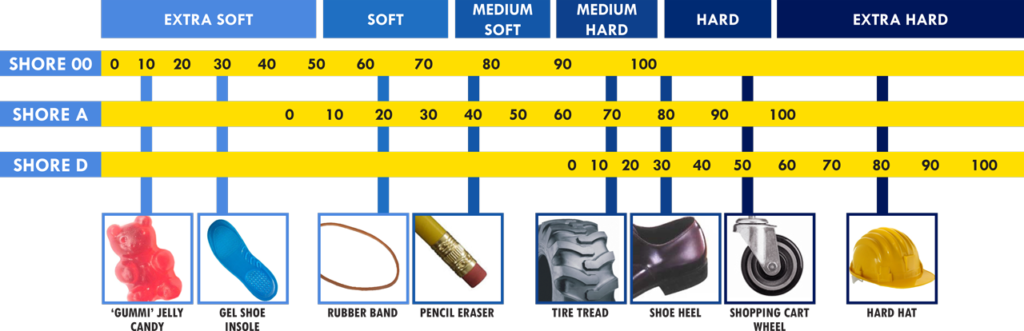
Figure 3. Comparison chart illustrating the relative hardness ranges of Shore 00, Shore A, and Shore D scales, with representative material examples for each hardness range. (Source: https://amesdirect.com.au/resources/understanding-shore-hardness/)
Application guidance: choosing the right Shore A hardness
Below are typical suitability guidelines. Exact hardness should be validated against joint design, loading, temperature, and tolerance stack-up.
Static sealing (gaskets, flanges, enclosures)
- 30A–60A is common depending on flange flatness and clamp load.
- Softer if surfaces are uneven or clamp load is limited.
- Firmer if extrusion resistance, shape retention, or higher pressure resistance is needed.
Door, hatch, and access panel seals
- 40A–70A is typical depending on closure force and sealing geometry.
- Softer reduces closing force; firmer improves durability and shape retention, especially for larger profiles.
Cable grommets and pass-through seals
- 30A–60A depending on insertion forces and sealing requirements.
- Softer improves conformity to cables; firmer improves tear resistance during repeated assembly.
Protective sleeves, edge trims, wear strips
- 50A–80A often preferred for durability and abrasion resistance.
- Consider surface finish and lubrication if sliding contact is involved.
Vibration isolation and cushioning
- 10A–40A depending on load, deflection targets, and frequency range.
- Hardness should be selected alongside geometry (thickness, area, voids) because shape often dominates stiffness.
High-pressure or extrusion-prone joints
- 60A–90A may be required, often with supporting design features (anti-extrusion lips, back-up rings, tighter gaps).
- Hardness alone is not a substitute for good gland design.
Important note: hardness is only one part of the specification
Two silicone materials can share the same Shore A hardness yet behave differently because of:
- Formulation and filler system
- Tear strength
- Elongation
- Compression set performance
- Temperature range and thermal ageing
- Media/chemical exposure
- Colour and additives (e.g., flame retardants, low smoke, antimicrobial, food-grade compliance)
For this reason, hardness should be treated as a starting point. For critical applications, it’s best to review a material’s full datasheet and confirm performance via prototypes or trials.
How Jehbco Silicones can help
Selecting Shore A hardness is ultimately about balancing sealing performance, durability, installation forces, and dimensional stability. Jehbco Silicones manufactures silicone extrusions across a wide range of hardness grades and can assist with:
- Hardness selection for your joint geometry and tolerance conditions
- Recommendations to reduce closing force while maintaining seal integrity
- Material options to improve tear resistance and service life
- Prototyping and iterative refinement for custom profiles
If you have an application in mind, provide your gap dimensions, mating material, expected compression, movement (if any), temperature range, and exposure environment, and our sales team can help narrow down a suitable Shore A hardness and compound type.
References
- ASTM International – https://www.astm.org/d2240-15r21.html
- Intertek – https://www.intertek.com/polymers-plastics/testlopedia/shore-hardness-astm-d2240/
- ISO – https://www.iso.org/standard/50756.html
- ASTM International – https://www.astm.org/d0395-18.html
- Parker Hannifin – https://www.parker.com/content/dam/Parker-com/Literature/O-Ring-Division-Literature/ORD-5700.pdf
- ZwickRoell – https://www.zwickroell.com/industries/plastics/thermoplastics-and-thermosetting-molding-materials/hardness-testing/shore-hardness-test/
- Linde Seals – https://www.lindeseals.com/news/what-is-shore-a-hardness-78017418.html
- AMES Direct – https://amesdirect.com.au/resources/understanding-shore-hardness/